
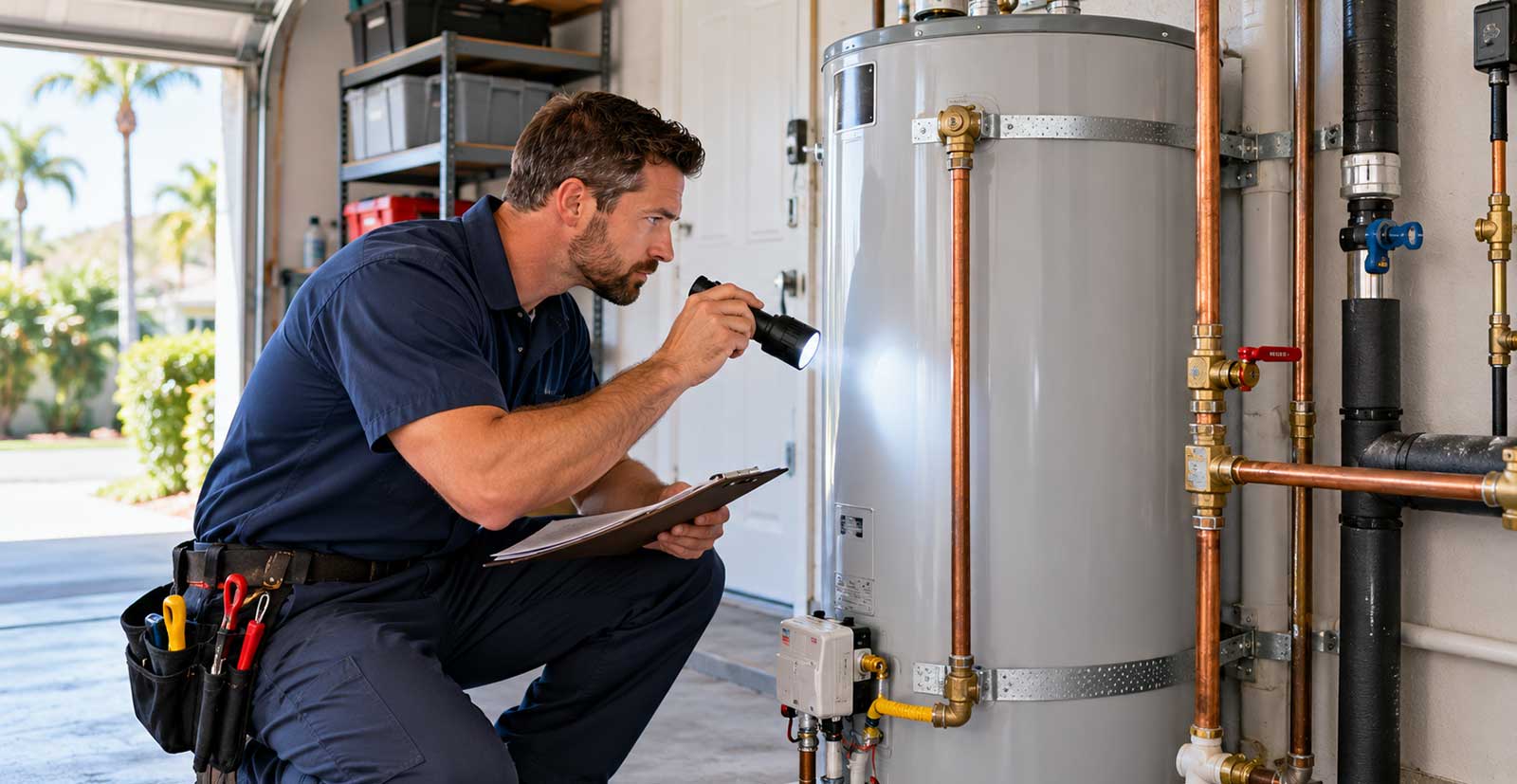
Why Is My Water Heater Making Popping Noises? A Florida Homeowner’s Guide
You’re enjoying a quiet evening when you hear something strange coming from the garage or utility closet. A popping sound. Maybe a low rumble or a series of little knocks.
At first, you might wonder whether something is wrong with the plumbing. Then you realize the noise is coming from your water heater.
A water heater that makes popping noises often signals sediment buildup inside the tank. The sound doesn’t automatically mean your water heater is failing, but it can signal a maintenance issue worth addressing.
For homeowners in Dunedin, Palm Harbor, Clearwater, and surrounding Tampa Bay communities, understanding what those noises mean can help prevent unexpected hot water problems and make maintenance decisions easier.
Why Is My Water Heater Making a Popping Noise?
The most common cause of popping or rumbling in a conventional tank-style water heater is sediment buildup near the bottom of the tank.
Over time, minerals and other particles carried by the water supply may settle inside the heater.
As heating continues, trapped water beneath or within sediment deposits can heat up enough to form steam bubbles. When those bubbles escape or collapse, they may produce popping, crackling, or rumbling sounds.
Imagine heating a pot of water with a layer of mineral deposits covering the bottom. The heat may not move through the deposits as efficiently, and the trapped water can behave differently from the rest.
A similar process can occur inside a water heater.
Water heater manufacturer A. O. Smith explains that popping and rumbling may result from accumulated sediment, aluminum hydroxide, or scale on heating elements.
The exact cause depends on the heater type and its condition.
What Does Florida’s Water Have to Do With It?
Water chemistry can significantly affect how quickly deposits build up inside plumbing equipment.
Many Florida water supplies contain naturally occurring minerals, though hardness varies by water source and local treatment system.
The two minerals most commonly associated with water hardness are calcium and magnesium.
According to the U.S. Geological Survey (USGS), water containing elevated concentrations of these minerals can contribute to scale deposits in pipes and water-using equipment.
When mineral-rich water is heated, some dissolved minerals can form solid deposits.
Over time, those deposits may collect in the bottom of a storage tank or form scale on heating surfaces.
Does Every Home in Pinellas County Have Hard Water?
Not necessarily.
Water quality can vary by municipality, private well, and home with a water-treatment system.
A household in Dunedin may have different water conditions from one in Palm Harbor, Safety Harbor, or New Port Richey.
That’s why it’s more useful to determine whether hard water contributes to a plumbing problem than to assume every home has the same mineral content.
If scale buildup recurs, professional water testing can help determine whether treatment is appropriate.
Other Water Heater Noises and What They Might Mean
Not every water heater sound indicates sediment buildup.
The type, timing, and location of the noise can provide useful clues.
Rumbling or Low Roaring
A deep rumbling sound may indicate sediment at the bottom of a tank-style heater.
As heating continues, water trapped beneath the deposits can produce noise.
If the sound becomes progressively louder, professional inspection is advisable.
Ticking or Light Clicking
Occasional ticking may be caused by normal expansion and contraction of metal components as the water heater or connected piping heats and cools.
However, persistent or unusual clicking may require further investigation, especially if it’s accompanied by heating problems.
Hissing or Sizzling
Hissing can have different causes.
It may occur when water contacts a hot surface or when moisture is present around heating components.
If the sound is accompanied by visible leakage, steam, or unusually high temperatures, stop using the equipment when it is safe to do so and contact a professional.
Banging or Knocking
Sharp banging may sometimes originate in the connected plumbing rather than inside the heater itself.
For example, water hammer occurs when flowing water stops or changes direction abruptly, creating a pressure surge in the piping.
A plumber can determine whether the noise comes from pipe movement, water pressure, a valve, or the heater.
Is a Water Heater Making Popping Noises Dangerous?
An occasional popping or rumbling sound caused by sediment is not automatically an emergency.
However, ignoring persistent noises isn’t a good idea.
Heavy sediment buildup can interfere with heat transfer, reduce performance, and make maintenance harder.
More importantly, some warning signs indicate problems beyond ordinary sediment accumulation.
Contact a qualified plumber promptly if you notice:
If you smell gas near a gas water heater, leave the area, avoid operating electrical switches or creating sparks, and contact your gas utility or emergency services from a safe location.
Never evaluate a water heater by sound alone when other warning signs are present.
Can Flushing a Water Heater Stop the Popping Noise?
Sometimes, yes.
Flushing a conventional storage-tank water heater can help remove loose sediment that has accumulated inside the tank.
If sediment is causing the noise, removing it may reduce or eliminate the popping and rumbling.
However, flushing doesn’t guarantee a solution.
Deposits can harden over time, and other mechanical or plumbing issues may cause noise.
A plumber should consider the heater’s age, maintenance history, and condition before recommending a flush.
Why Water Heater Maintenance Matters
The U.S. Department of Energy’s Energy Saver Guide identifies water heating as a major household energy expense and includes sediment removal among its maintenance considerations.
Regular water heater maintenance may involve:
The appropriate procedures and maintenance intervals vary by manufacturer and heater type.
If you’re unfamiliar with the equipment or its maintenance requirements, professional service is the safer choice.
For additional manufacturer guidance, see A. O. Smith’s Water Heater Maintenance Guide.
Plumbing Services by Gus provides professional water heater services for conventional and tankless systems throughout the Dunedin area.
What If Your Water Heater Still Makes Noise After Flushing?
If popping or rumbling continues after appropriate maintenance, the problem deserves further investigation.
Possible causes include hardened mineral scale, deposits that weren’t fully removed, or noise from a source unrelated to sediment.
Electric and gas water heaters use different heating methods and components, so troubleshooting varies by system.
A plumber can evaluate the heater’s performance and determine whether additional service is likely to help.
Sometimes, repairing the existing heater makes sense. In other cases, age, corrosion, repeated problems, or the tank’s condition may make replacement more practical.
The goal isn’t to replace a water heater just because it makes an unfamiliar sound.
The goal is to determine whether the sound reflects a correctable maintenance issue or a more serious problem.
Should You Repair or Replace a Noisy Water Heater?
The decision depends on more than the noise.
Consider the following questions.
How old is the water heater?
An older tank may be nearing the end of its useful life, especially if it has already had several problems.
Has it received regular maintenance?
A heater with a long history of sediment accumulation may have deposits that are difficult to remove completely.
Is the tank leaking?
A leaking storage tank generally requires replacement rather than a simple component repair.
Is the heater still providing enough hot water?
Reduced capacity, inconsistent temperatures, or repeated loss of hot water may indicate other issues that should be diagnosed.
Are repair costs becoming frequent?
When repeated repairs become costly, replacing the unit may offer better long-term value.
A professional evaluation can help homeowners compare repair costs, equipment condition, and replacement options without making an unnecessary investment.
Plumbing Services by Gus works with gas, electric, hybrid heat pump, conventional tank, and tankless water heaters, including brands such as Bradford White, A. O. Smith, Rheem, Navien, and Rinnai.
Can Water Treatment Help Reduce Sediment Buildup?
If a home’s water contains elevated hardness minerals, an appropriately selected water softener may help reduce scale formation in water-using equipment.
However, not all filtration systems remove hardness.
A sediment filter is designed to capture certain suspended particles, while conventional ion-exchange water softeners target dissolved calcium and magnesium.
These systems solve different water-quality problems.
That’s why you should test your water and evaluate your household’s needs before selecting equipment.
Plumbing Services by Gus provides water purification and treatment services to help homeowners evaluate water-quality concerns and explore appropriate solutions.
Water treatment doesn’t replace regular water heater maintenance, but it can be part of a broader equipment-care strategy when water chemistry contributes to recurring deposits.
Need Help With a Noisy Water Heater in Dunedin, FL?
A popping water heater can be annoying, but it can also be an opportunity to address a maintenance problem before your hot water supply becomes unreliable.
Plumbing Services by Gus is a family-owned and operated plumbing company based in Dunedin, Florida, with local plumbing experience dating back to 1971.
With Master Plumbers on staff and Florida license CFC-1428321, our team provides water heater troubleshooting, maintenance, repair, and replacement for homeowners throughout Pinellas, Pasco, Hillsborough, and Polk counties.
Whether your water heater needs a routine evaluation, sediment removal, or a professional opinion about replacement, we’re here to help you understand the options.
Don’t Let Strange Water Heater Noises Leave You in Cold Water

If wastewater is coming back into your home or recurring drainage problems are raising concerns, don’t wait for the next storm to make it worse.
Contact Plumbing Services by Gus for professional diagnosis and repair.
Don’t Cuss… Call Gus!